
When you choose a TikTok Shop agency, compare it on verified TikTok Shop Partner status, in-house live-selling capacity, creator network size, content volume, fulfillment handling, and reporting quality, then match the pricing model to your margins. To choose a TikTok Shop agency well, start by knowing the three models brands face: retainer or hourly agencies, managed services that charge a base plus commission, and buy-and-sell partners that purchase your inventory outright and carry the risk. Each model fits a different kind of brand, so the right comparison depends on your sales history, your margins, and how much of the operation you want someone else to run.
Key takeaways
- There are three agency models: retainer/hourly, managed services (base plus commission), and buy-and-sell partners who purchase inventory. Match the model to your margins and risk tolerance.
- Verify current TikTok Shop Partner status directly with TikTok, because directories and agency claims go stale.
- In-house live-selling capacity, creator network size, and monthly content volume are the operational differentiators most brands underweight.
- "TikTok Shop management" ranges from affiliate outreach alone to full P&L ownership. Pin down the exact scope in writing.
- Platinum Commerce runs both managed services and buy & sell in-house, having generated $100M+ in GMV for 100+ brands as of 2026.
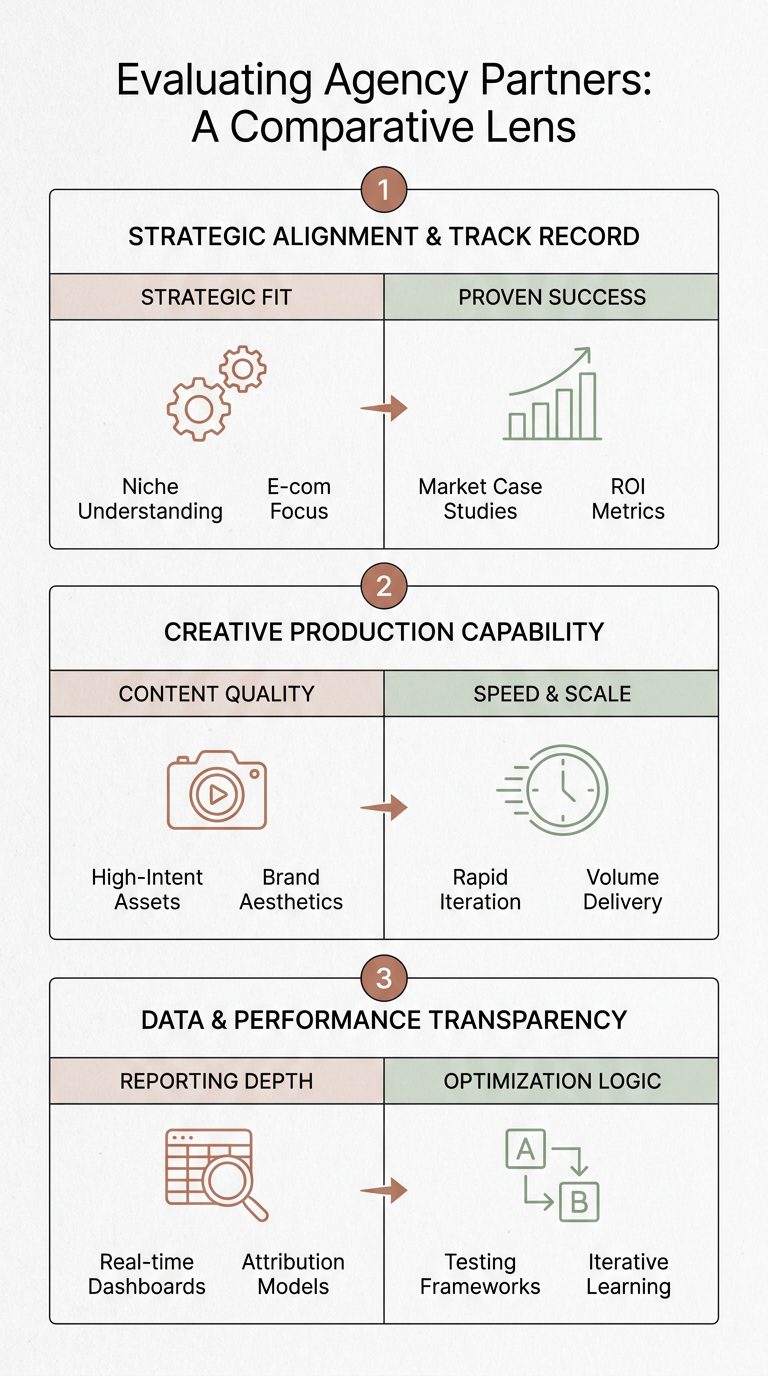
Table of contents
- How to Choose a TikTok Shop Agency: Step by Step
- Step 1: Verify TikTok Shop Partner Certification
- Step 2: Assess Live-Selling Capacity In-House
- Step 3: Evaluate Creator and Affiliate Network Size
- Step 4: Check Content Production Volume
- Step 5: Understand Fulfillment and Inventory Handling
- Step 6: Review Reporting and Performance Metrics
- Step 7: Compare Pricing Models Against Your Budget
- Who This Approach Is NOT For
- Common Mistakes That Derail Agency Selection
- FAQ
How to Choose a TikTok Shop Agency: Step by Step
Choosing a TikTok Shop agency comes down to picking one of three commercial models and then verifying the operation behind it. The model decides who carries risk and how you pay; the verification steps that follow decide whether the agency can actually do the work. Here is how the three models compare.
| Model | How you pay | Who carries inventory risk | Best fit |
|---|---|---|---|
| Retainer / hourly | Fixed monthly fee or hourly, paid regardless of sales | You | Brands wanting advisory help while keeping full control |
| Managed services | Base fee plus commission on sales | You | Brands with a proven product and margin room |
| Buy & sell partner | No fee; partner buys your inventory at PO cost | The partner | Brands wanting cash up front and zero operating risk |
A 2026 agency selection framework recommends comparing agencies on verified TikTok Shop experience, creator-affiliate operations, Shop Ads capability, live commerce, fulfillment knowledge, reporting quality, and contract economics rather than follower count alone. Platinum Commerce runs both managed services and buy & sell distribution, so a brand can keep inventory and pay base plus commission, or sell inventory outright with no fees.
Step 1: Verify TikTok Shop Partner Certification
Confirm the agency holds current TikTok Shop Partner status and ask for written proof of its partnership tier and any specializations. A "TikTok Shop Agency Partner" is an agency recognized within TikTok's partner ecosystem for services such as creator activation, affiliate management, content, live commerce, or advertising.
Verify this directly with TikTok rather than trusting a logo on a website. As the TikTok Shop seller newsroom and independent coverage both note, third-party directories and agency claims go out of date, so a current certification check matters. For example, TBAR Partners was an official TikTok Shop Agency Partner before Common Thread Collective acquired it in September 2026; ownership and status can shift fast.
Done looks like: written verification of the agency's current partnership tier and listed specializations, cross-checked against TikTok's own records. Platinum Commerce is a certified TikTok Shop Partner and can confirm its status on request.
Step 2: Assess Live-Selling Capacity In-House
Ask whether the agency operates its own live-streaming studio or outsources broadcasts, then request its monthly LIVE volume and whether that capacity is dedicated to your brand or shared across clients. Live selling is where many brands lose the most GMV to weak execution, because it needs trained hosts, scripts, moderation, and offer management, not just a camera.
In-house infrastructure is the differentiator. According to Platinum Commerce's 2026 studio data, it streams TikTok LIVE shopping from 9 branded live selling bays in its Beverly Hills studio, and Platinum Commerce ranked #1 in TikTok Shop's Multi-Category Seller Live Sprint. That kind of dedicated capacity is what you are testing for.
Done looks like: a concrete figure for monthly LIVE broadcast hours and a clear statement of whether your brand gets dedicated bays and hosts or shares a rotation. See how Platinum runs daily live selling for the model to compare against.
Step 3: Evaluate Creator and Affiliate Network Size
Ask for the total creator network the agency can mobilize and, separately, how many creators it can dedicate to your products with what usage or exclusivity terms. Network size matters because TikTok Shop sales are driven heavily by affiliate creators, and a larger, well-managed pool gives more shots at a video that converts.
Dig past the headline number. One 2026 agency directory reports figures like 3,000-plus vetted creators and more than $500 million in managed GMV across 150-plus brands for a single agency, but notes these are company-reported rather than independently audited. According to Platinum Commerce's 2026 creator network records, it works with a network of more than 20,000 TikTok creators ranging from 5K to 20M followers, managed through an in-house affiliate sample center.
Done looks like: written confirmation of total network scale plus the number of creators the agency will assign to your brand, and the terms. Platinum's affiliate and creator management sits inside its full program.
Step 4: Check Content Production Volume
Request the agency's monthly video output capacity and its turnaround time for new product content. Volume matters because TikTok Shop rewards constant creative testing: hooks, creators, offers, and product angles all need fresh video, and a thin content pipeline starves both organic reach and ads.
Ask for a number, not an adjective. A full TikTok Shop content scope should cover UGC for product pages, affiliate videos, and ad creative, with a testing plan behind it. According to Platinum Commerce's 2026 content production records, it produces more than 7,000 creator videos a month in-house, built specifically for TikTok Shop product pages, affiliates, and ads.
Done looks like: a concrete videos-per-month figure and a stated production timeline for new SKUs, so you know whether a launch will have the creative volume it needs in week one, not week six.
Step 5: Understand Fulfillment and Inventory Handling
Clarify whether the agency holds inventory, dropships, or coordinates with your warehouse, and establish in writing who bears return and refund responsibility. Fulfillment is where the three models diverge most, so this step is really about the commercial deal underneath the marketing.
The split is straightforward:
- Managed services: you keep inventory and fulfillment; the agency runs the shop and coordinates orders, returns, and customer service.
- Buy & sell: the partner purchases your inventory and owns fulfillment, returns, and the P&L entirely.
Platinum Commerce offers both. Under buy & sell it buys inventory at net PO cost, paid up front and backed by a $100M credit line, and according to Platinum Commerce's 2026 distribution data it sells across more than 25 marketplaces and channels in 7 countries through a dozen 3PL centers.
Done looks like: a written agreement naming each party's fulfillment role and liability for returns and refunds.
Step 6: Review Reporting and Performance Metrics
Request sample dashboards or reports before signing, and confirm they separate organic, affiliate, live, and paid sales. Reporting quality tells you whether an agency actually understands TikTok Shop, because blended "total sales" numbers hide which channel is working and which is burning budget.
This matters more under TikTok's recent changes. Per TikTok's 2025 to 2026 seller updates, store-level actual GMV now displays across Seller Center sections while commission metrics stay in Affiliate Center, and GMV Max has become the default ads solution in some markets. A good report shows what the agency controls inside GMV Max, how it prevents spend from concentrating on low-margin SKUs, and reports paid results apart from affiliate and organic.
Done looks like: access to real-time or weekly metrics covering GMV, ROAS, creator performance, and sell-through. Platinum's data and reporting consolidates shop, live, and affiliate results in one view.
Step 7: Compare Pricing Models Against Your Budget
Request full fee structures for all three models and calculate true cost against your expected sales volume, not a best-case scenario. The headline price is misleading on its own: a retainer looks cheap until sales are flat, and a commission looks expensive until you factor in the risk the partner absorbs.
Work the math per model:
- Retainer/hourly: fixed cost you pay whether or not sales land. Platinum Commerce does not offer this model.
- Managed services: base plus commission, so cost scales with sales and your margin has to carry the commission.
- Buy & sell: no fee to you; the partner's margin comes from reselling inventory it bought, so your risk is near zero.
Platinum Commerce ran a $1.1M TikTok Black Friday campaign in 2025, which is the kind of concrete volume figure to anchor a breakeven calculation against. Ask any agency for its managed services terms in writing.
Done looks like: a written proposal with no hidden fees and stated breakeven assumptions.
Who This Approach Is NOT For
This seven-step evaluation is built for consumer brands with a sellable product that already fits TikTok's audience. It is not the right process for every situation.
- Pre-product and zero-history brands: if you have no product shipping yet, agency selection is premature. Platinum Commerce does not serve pre-product brands; build and validate the product first.
- Audiences outside TikTok's core: if your buyers are not on TikTok, prioritize channel fit before agency fit, because no agency can manufacture demand that is not there.
- Very small brands: managed services base-plus-commission fees may not pencil out at low volume. A buy & sell arrangement, where the partner carries cost and risk, often fits better than paying a managed-services base.
If you only want hourly consulting, software, or standalone ad management without TikTok Shop, this framework and Platinum's model are not the match; those are different services entirely.
Common Mistakes That Derail Agency Selection
The three mistakes below sink more agency decisions than any pricing disagreement.
-
Choosing on price alone without checking partner status. The cheapest proposal is worthless if the agency's certification has lapsed or never existed. Verify current TikTok Shop Partner status with TikTok first, then compare price.
-
Treating live-selling infrastructure as an afterthought. Live commerce is a core TikTok Shop revenue driver, and agencies that outsource streams or lack dedicated studio capacity usually underperform. Platinum Commerce's 9 branded live bays and #1 Multi-Category Seller Live Sprint ranking in 2026 show the kind of in-house capacity worth comparing against.
-
Signing long-term contracts before seeing baseline metrics. Commit to a short proving period with transparent reporting before any multi-month lock-in. If an agency will not show channel-separated performance data early, that is your answer.
FAQ
How do I verify a TikTok Shop partner is certified?
Confirm the agency's status directly with TikTok rather than relying on a badge or a directory listing, because partner status and ownership change. TBAR Partners, for instance, was an official TikTok Shop Agency Partner before Common Thread Collective acquired it in September 2026. Ask for written proof of the partnership tier and specializations.
What is the difference between managed services and a buy-and-sell partner?
Under managed services you keep your inventory and fulfillment and pay a base fee plus commission while the agency runs your shop. Under buy & sell, the partner purchases your inventory outright at PO cost, pays you up front, and owns the fulfillment, returns, and P&L. Platinum Commerce offers both models.
What makes the best TikTok Shop agency for my brand?
The best TikTok Shop agency for your brand is the one whose model matches your margins and risk tolerance and that can prove in-house live-selling, creator network, content volume, and channel-separated reporting. There is no single winner for every brand; a high-margin brand with capital may prefer managed services, while a brand wanting zero risk may prefer buy & sell.
How much does TikTok Shop management cost?
It depends on the model. Retainer and hourly work is a fixed cost paid regardless of sales. Managed services charge a base fee plus commission, so cost scales with GMV. Buy & sell carries no fee to the brand because the partner earns its margin reselling inventory it purchased. Always calculate true cost against realistic sales volume.
Sources
- TikTok Shop seller newsroom and seller updates
- citybiz: Common Thread Collective acquires TBAR Partners
- Hubfluence: best TikTok Shop agencies
Written by Ashton Asherian