
You find TikTok Shop affiliates by identifying creators with engaged audiences in your niche, vetting them for audience alignment and production quality over follower count, and offering a commission structure that pays for conversions, not vanity metrics. Knowing how to find TikTok Shop affiliates is less about chasing big accounts and more about matching the right creator to the right product and then paying them well enough to keep posting.
We run this process every day. At Platinum Commerce, our in-house team sources, samples, and manages affiliates, starting with creators who already sell your category. Here is the exact path we follow, with real benchmarks and the places it breaks down.
Key takeaways
- Recruit affiliates in two lanes inside TikTok Shop: Open Collaboration for broad testing and Target Collaboration for curated, higher-fit creators.
- Vet on engagement rate, audience match, and content consistency. Follower count is the weakest signal.
- Published 2025 third-party guides report commission rates of 2%-20% across categories, with electronics at the low end and beauty at the high end.
- Expect 5%-15% response rates on cold outreach, higher when the creator already knows your brand.
- This method needs a TikTok Shop seller account, a product with real demand, and a budget for samples and commissions. It does not work for website-only brands.
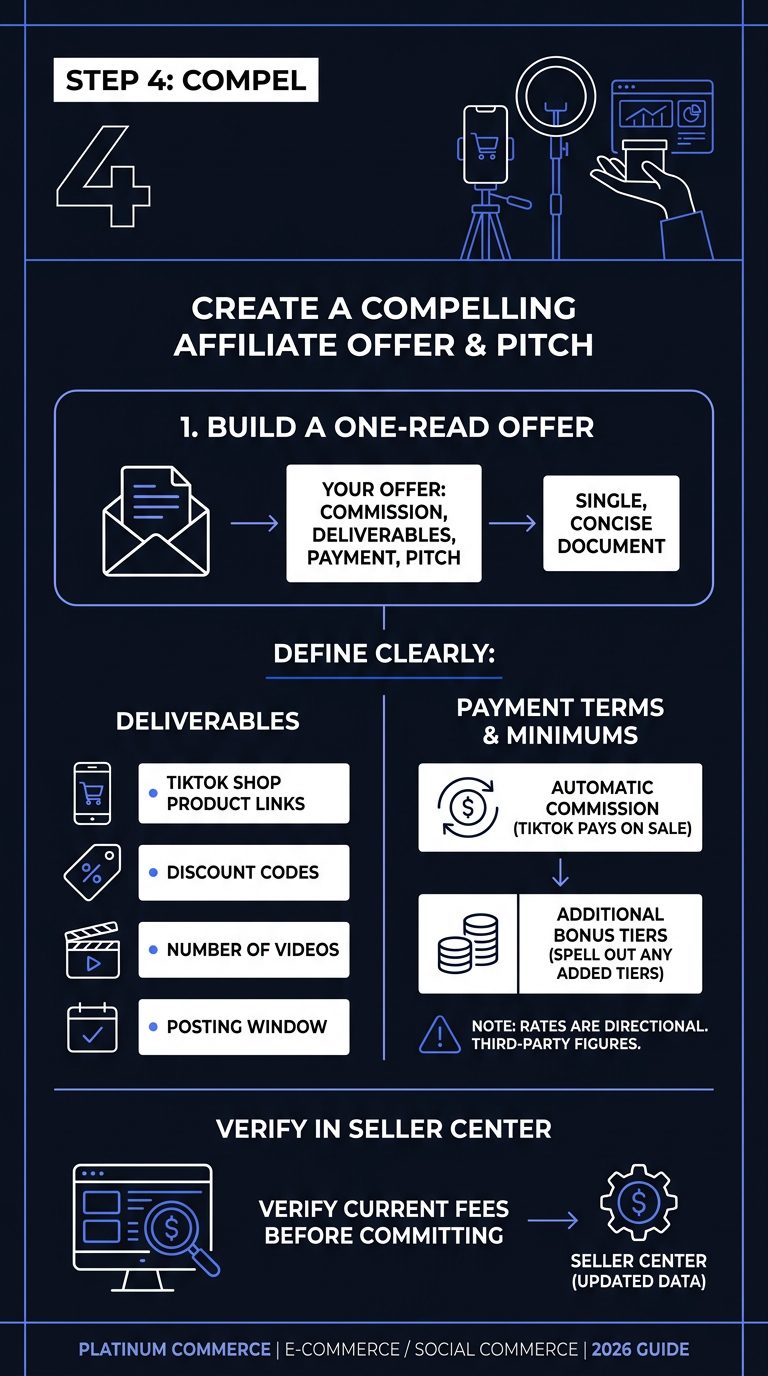
Table of contents
- How to Find and Recruit TikTok Shop Affiliates: The Direct Path
- Step 1: Define Your Ideal Affiliate Profile and Budget
- Step 2: Source Creators Across TikTok and Creator Platforms
- Step 3: Vet Creators for Audience Quality, Not Just Follower Count
- Step 4: Create a Compelling Affiliate Offer and Pitch
- Step 5: Reach Out with Personalized, One-to-One Outreach
- Step 6: Onboard Affiliates Into Your TikTok Shop and Tracking System
- Step 7: Support Affiliates and Iterate on Top Performers
- Where This Approach Breaks Down: Affiliate Programs That Won't Work
- Common Mistakes That Derail Affiliate Recruitment
- FAQ
How to Find and Recruit TikTok Shop Affiliates: The Direct Path
The fastest way to find and recruit TikTok Shop affiliates is to work inside TikTok Shop's own affiliate workflow, then layer manual outreach on top. In Seller Center, you open Affiliate → Get Started and choose between two collaboration types, as described in TikTok Shop's affiliate documentation.
- Open Collaboration: You list products with a commission rate and eligible creators discover and promote them. Best for broad discovery and testing demand without recruiting each creator by hand.
- Target Collaboration: You invite specific creators with a custom brief and terms. Best when you need tighter brand fit, a seeding plan, or a defined creator profile.
The model is sale-based. TikTok pays the commission automatically when a creator-generated sale occurs, so your upfront media risk is low. You still carry sample, fulfillment, discount, and return costs. A good target: creators who convert at 2%-5%, not the ones with the biggest follower numbers.
Step 1: Define Your Ideal Affiliate Profile and Budget
Start by writing down exactly who you want to promote your product and how much you will spend to get them. Map your category and price point to a creator tier before you message anyone.
Document these requirements:
- Minimum follower count by tier (we treat 5K as a floor for most consumer products).
- Audience demographics: location (US buyers for a US shop), age, and buyer-intent signals.
- Niche fit: does the creator already make content about your category?
- Production standards: lighting, pacing, clear product demos.
Set your recruitment budget as a percentage of expected GMV. Commission is the biggest line. Published 2025 guides from Advertise Purple report roughly 10%-15% as an open-plan baseline and 15%-25% or more for targeted collaborations. Add sample cost, shipping, and any discount codes. For electronics and home, test the lowest rate that produces qualified uptake, then raise it for proven converters.
Done looks like: a one-page affiliate spec and a monthly budget number you can defend.
Step 2: Source Creators Across TikTok and Creator Platforms
Source affiliates from three places at once so you are never dependent on a single channel. Scout directly on TikTok, use creator platforms, and mine your own existing fans.
- TikTok Discover and hashtag search. Search your category hashtags and product terms. Watch who posts consistently and gets real comments, not just views.
- TikTok Shop's own creator tools. Inside Seller Center, creators can browse products, find brands seeking creators, view trending products, and request samples, as outlined in TikTok Shop's creator resources. Open Collaboration surfaces you to them automatically.
- Creator platforms and marketplaces. Third-party tools let you filter by audience and past e-commerce performance.
- Your existing fans and commenters. The people already posting about your category are the warmest leads you have.
Log the sourcing method for every creator in a spreadsheet. After a month you will see which channel yields converters versus content that never sells.
Done looks like: a list of 50 to 150 candidate creators, each tagged with where you found them.
Step 3: Vet Creators for Audience Quality, Not Just Follower Count
Vet creators on engagement and audience match, because follower count tells you almost nothing about who will buy. A 40K-follower creator in your exact niche routinely outsells a 500K generalist.
Check these signals before you reach out:
- Engagement rate: comments, saves, and shares per video, not follows. Thin comments under big view counts is a red flag for bought reach.
- Audience demographics: location, age, and buyer intent. A US TikTok Shop needs a US-weighted audience.
- Content quality and consistency: do they post weekly, and do their product videos actually demo the item?
- Fake-follower screen: sudden follower spikes, generic comments, and low watch time all point to inflated accounts.
Use TikTok Analytics or a third-party audience tool to confirm the audience matches your target customer. We run this on every creator before a sample ships, because a sample sent to the wrong audience is money gone. For the vocabulary here, our affiliate and creator management overview breaks down how we structure network vetting at scale.
Done looks like: a shortlist where every creator passes your engagement and audience thresholds.
Step 4: Create a Compelling Affiliate Offer and Pitch
Build an offer a creator can say yes to in one read. The offer is your commission, your deliverables, your payment terms, and a short pitch, all in one place.
Define clearly:
- Commission: a percentage of sale or a flat rate per conversion. Reported 2026 third-party ranges put 5%-15% as common for general merchandise, with one source reporting an effective average near 13%.
- Deliverables: TikTok Shop product links, discount codes, number of videos, posting window.
- Payment terms and minimums: TikTok pays commission automatically on each sale, so spell out any added bonus tiers.
Attach a one-pager: product images, three key selling points, example hooks, and dos and don'ts. The table below shows how the two collaboration models and rates compare.
| Offer type | Typical commission (2025-2026, third-party) | Best for |
|---|---|---|
| Open Collaboration | 10%-15% baseline | Broad testing, product discovery |
| Target Collaboration | 15%-25%+ | Tight brand fit, seeding plans |
| Electronics (indicative) | 2%-8% | Low-margin, high-AOV products |
| Beauty / personal care | Up to 20% | High-margin impulse buys |
Rates above are directional third-party figures, not official TikTok benchmarks. Verify current fees in Seller Center before you commit.
Done looks like: a saved offer doc and one-pager you can send in under a minute.
Step 5: Reach Out with Personalized, One-to-One Outreach
Reach out one creator at a time, and reference something specific they actually made. Generic blasts are the single fastest way to get ignored.
Your message should:
- Name a specific video of theirs and why it fit your product.
- State the commission and what you are sending (the sample).
- Link to apply or join your TikTok Shop collaboration.
- Give one clear call to action.
Contact them via the channel they list: Instagram DM, email, or TikTok DM if open. Expect 5%-15% response rates on genuinely cold outreach. That rate climbs sharply when the creator already knows your brand or has bought from you, which is why Step 2's warm list matters.
Keep it to five sentences. Busy creators skim.
Done looks like: personalized messages sent to your full shortlist, tracked by response.
Step 6: Onboard Affiliates Into Your TikTok Shop and Tracking System
Onboard every creator who says yes into TikTok Shop's affiliate program so each sale is tracked back to them. Without unique attribution you cannot tell a converter from a coaster.
Onboarding checklist:
- Register the creator in TikTok Shop's affiliate program and confirm their collaboration shows the agreed commission.
- Ship a sample through the Sample Center. Treat sample fulfillment as a controlled acquisition cost: only creators whose audience and content justify the expense get one.
- Send brand guidelines, your best-performing video examples, and the commission schedule.
- Confirm the creator understands deliverables and timing before the first post.
Track creator-level GMV, orders, conversion rate, refunded orders, content output, and sample-to-content rate, as TikTok's affiliate reporting supports creator-tied metrics per its affiliate workflow documentation. We produce more than 7,000 creator videos a month, according to Platinum Commerce's 2026 content production records, and that volume only works because every creator is tracked from day one.
Done looks like: each active creator is registered, sampled, and firing on their own tracking link.
Step 7: Support Affiliates and Iterate on Top Performers
Support your affiliates weekly and concentrate budget on the ones who convert. The job is not done at recruitment. The 80/20 rule is brutal here: a small group of creators drives most of your GMV.
Each week:
- Review views, clicks, conversions, and commission earned per creator.
- Pay commissions on time. Nothing kills a creator relationship faster than a late payout.
- Double down on creators hitting 2%-5% conversion. Send them new products, higher rates, and live-selling invites.
- Pause underperformers after 2 to 4 weeks if they fall below ~0.5% conversion or never publish, and tell them why.
Feed your top creators into live selling. We stream TikTok LIVE shopping from 12 live rooms, according to Platinum Commerce's 2026 studio records, and the affiliates who convert on short-form are usually the ones worth putting on a live show. See how we run that on our live selling page.
Done looks like: a ranked roster, on-time payments, and budget shifting toward proven converters.
Where This Approach Breaks Down: Affiliate Programs That Won't Work
This method assumes three things: you have a TikTok Shop seller account, a product with clear product-market fit, and a willingness to pay commission on every sale. Remove any one and affiliate recruitment stalls.
It does not work for:
- Website-only brands. No TikTok Shop means no native affiliate tracking or automatic commission. Set up the shop first.
- Very small budgets. Under roughly $5K a month, you cannot sample enough creators or survive the testing phase where most creators do not convert.
- Pre-product or unproven demand. If nobody wants the product, paying creators more just loses money faster. Affiliates amplify demand, they do not manufacture it.
- Low-margin products with no room for commission. If a 2%-8% electronics rate still breaks your unit economics, fix margin or price before recruiting.
If you sell electronics, home, gaming, or lifestyle products and the budget is there, this is exactly the work our team runs end to end. If your Amazon playbook is shaping your expectations, read why your Amazon strategy won't work on TikTok Shop first.
Common Mistakes That Derail Affiliate Recruitment
The mistakes that sink affiliate programs are predictable, and almost all of them come from treating recruitment as a numbers game instead of a relationship.
- Recruiting on follower count alone. Big accounts with dead engagement will take your sample and sell nothing.
- Generic pitches. A message that never names the creator's work reads as spam and gets ignored.
- Commissions set too low. If your rate sits under what creators can earn elsewhere, your offer never surfaces. Test, then raise for converters.
- Late or missing payments. This ends relationships and your reputation travels fast in creator circles.
- Abandoning underperformers silently. Give feedback before you pause someone. Some just need a better hook or a different product.
- Launching too many creators at once. You lose the ability to see what is working and cannot support anyone properly.
We decide between buying your inventory outright with no fees, or running your shop on managed services while you keep inventory, based on your margins and goals. Book a call and we will tell you which fits.
FAQ
How do I find TikTok Shop affiliates for free?
Use TikTok Shop's Open Collaboration inside Seller Center to list products with a commission rate so eligible creators discover you without paid recruitment. Pair it with manual TikTok Discover and hashtag searches, plus outreach to your own fans and commenters. The commission is only paid when a sale happens, so there is no upfront media cost, though samples and shipping still cost money.
What commission should I offer TikTok Shop affiliates in 2026?
Published 2025-2026 third-party guides report 2%-20% across categories: electronics around 2%-8%, general merchandise 5%-15%, and targeted collaborations 15%-25% or more. These are directional, not official TikTok benchmarks. Start at the lowest rate that attracts qualified creators, then raise commissions selectively for proven converters.
How many followers should a TikTok Shop affiliate have?
There is no universal minimum. We treat around 5K as a working floor for most consumer products, but audience match and engagement rate matter far more than raw follower count. A niche creator with 40K engaged, US-based followers often outsells a 500K generalist.
What is the difference between Open and Target Collaboration?
Open Collaboration lists your product to all eligible creators for broad discovery and testing, while Target Collaboration lets you invite specific creators with a custom brief and terms. Use Open to find demand and Target when you need tight brand fit or a seeding plan.
How long until affiliates start driving sales?
Plan for a 2 to 4 week testing window per creator before you judge performance. Most creators will not convert, so recruit in batches, pause those below ~0.5% conversion, and reinvest in the ones hitting 2%-5%.