Hire a TikTok Shop agency if you need speed to revenue and creator scale without carrying overhead; build in-house if you're large enough to fund 3 to 6 full-time staff and you want full control of strategy and data. That is the short version of the tiktok shop agency vs in-house decision, and it comes down to two things: your cash position and your timeline.
The rest comes down to specifics. A new team takes four to six months to get productive. An agency with a live studio and a creator network can have you selling in weeks. But an agency cannot override TikTok's own automation, and it does not own your product economics the way an internal team does. Below we weigh both options across the criteria brand leaders actually use, and we name the winner of each one.
Key takeaways
- Agencies win on speed. Platinum Commerce typically moves a brand from onboarding to live selling in about 10 weeks, versus four to six months to hire and train an internal team.
- Agencies win decisively on creator scale. An established creator network and 7,000+ videos a month is not something an in-house team of 10 to 50 creator relationships can match quickly.
- In-house wins on strategic control and data ownership, which matters most for brands with a fixed product vision and the staff to enforce it.
- TikTok's own automation now sets the ceiling. GMV Max, launched in 2024, automatically directs spend across organic, paid, and affiliate content, so neither an agency nor an internal team fully controls campaign delivery.
- The hybrid path is real: many brands launch with an agency, then build in-house as volume and cash flow stabilize.
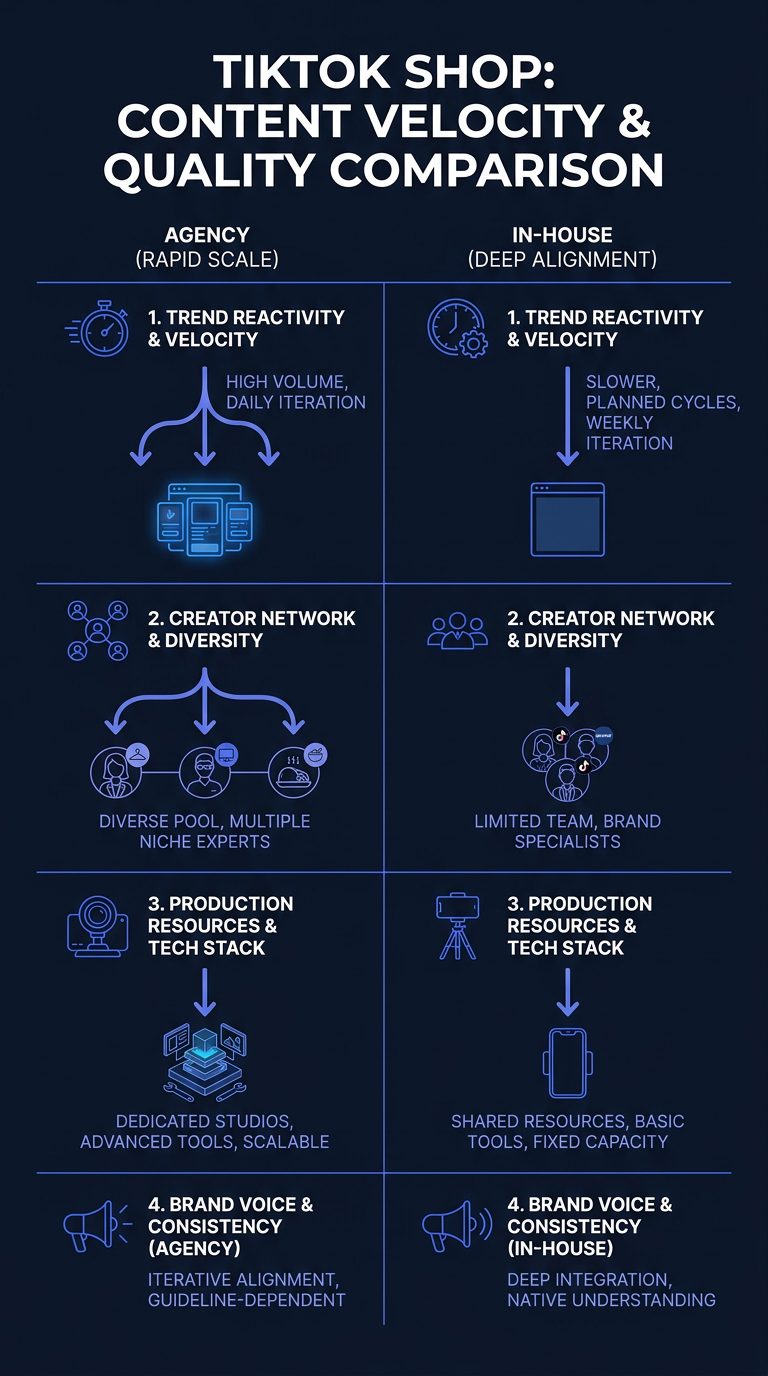
Table of contents
- Agency vs In-House: Which Wins for TikTok Shop?
- Comparison: TikTok Shop Agency vs In-House Team
- Speed to Revenue: Which Gets You Selling Faster?
- Creator Access and Scale: Who Reaches More Viewers?
- Strategic Control: Who Decides Your Direction?
- Scaling Beyond Launch: Agencies Then In-House?
- FAQ
Agency vs In-House: Which Wins for TikTok Shop?
For most consumer product brands launching on TikTok Shop, an agency wins at the start and in-house wins at scale. Hire an agency when you need revenue fast, lack a creator network, and don't want to carry fixed payroll before you've proven the channel. Build in-house when TikTok Shop is already a material revenue line, your margins can absorb 3 to 6 salaries, and you want to own strategy and data outright.
The decision hinges on cash and timeline, not preference. An internal team is a fixed cost from day one and takes months to become productive. An agency converts that fixed cost into a variable one tied to output. At Platinum Commerce we run both sides in-house from our Beverly Hills studio: live selling, creators and affiliates, UGC, GMV Max ads, and fulfillment. That is the lens for every comparison below.
One more factor now shapes the whole decision. TikTok is automating the channel itself.
Comparison: TikTok Shop Agency vs In-House Team
Here is the side-by-side on the seven criteria brand leaders weigh most. Ranges reflect 2026 market observations and our own operating experience; your numbers will vary by category and margin.
| Criteria | TikTok Shop Agency | In-House Team |
|---|---|---|
| Setup cost | Low; onboarding, no hiring | High; recruiting, equipment, studio space |
| Monthly burn | Variable: management fee or commission; media and creator costs pass through | Fixed: 3 to 6 salaries plus benefits and tools |
| Time to first sales | ~10 weeks (Platinum Commerce onboarding) | 4 to 6 months to hire and train |
| Creator access | Established network | Built slowly; typically 10 to 50 creators |
| Platform expertise | Deep, current, operates daily across many brands | Learns on your dime; strong once seasoned |
| Strategic control | Agency recommends; you approve | Full; your team owns direction and data |
| Ongoing flexibility | Scale up or down by contract | Slower to flex; hiring and layoffs are costly |
Published agency pricing is broad and usually excludes pass-through costs. A 2026 agency comparison from Top Growth Marketing lists monthly management from about $5,000 to $6,500 at the low end, with one provider quoting $5,000 to $50,000-plus per month plus 10% to 30% of GMV. A management fee or revenue share should never be compared against payroll alone. Creator commissions, referral fees, coupons, samples, shipping, returns, and paid media all have to be modeled separately.
Speed to Revenue: Which Gets You Selling Faster?
An agency gets you selling faster, by months. According to Platinum Commerce's 2026 onboarding timelines, brands typically go from onboarding to live selling in about 10 weeks. A new internal team, by contrast, takes four to six months to hire, train, and become productive, and that clock doesn't start until you've found the people.
The gap is structural. An agency already has the studio, the hosts, the creator pipeline, and the reporting running. You plug your catalog in. An in-house build runs the opposite way: you recruit a shop manager, a creator manager, a content lead, and a live host, then wait while they learn TikTok Shop's quirks and build relationships from zero.
Speed matters more here than on most channels because the algorithm rewards volume early. You can see how we structure the launch window on our how it works page. Winner: agency, and it isn't close for brands that need revenue this quarter.
Creator Access and Scale: Who Reaches More Viewers?
An agency reaches far more viewers, because it already operates a creator network at scale. According to Platinum Commerce's 2026 content production records, we produce more than 7,000 creator videos a month. An in-house team usually works with 10 to 50 creators and builds those relationships slowly, one outreach at a time.
Scale compounds on TikTok Shop. More creators means more videos, more videos means more at-bats for the algorithm, and the content that hits feeds GMV Max's optimization. TikTok's GMV Max, launched in 2024, combines organic videos, paid ads, and affiliate posts, then automatically directs spend toward content it predicts will sell. A deeper content pool gives that engine more to work with.
Commission rates are seller-controlled, from 1% to 80% of eligible sales in 2026 per TikTok's seller materials. Our affiliate and creator management runs sampling and payouts across that network. Winner: agency, decisively, on creator reach.
Strategic Control: Who Decides Your Direction?
In-house wins on strategic control. An internal team executes your vision directly, makes the final call on every decision, and owns the first-party data outright. An agency recommends strategy and operates the channel, but your team still has to approve direction, and some of the data sits with the partner. For a brand with a fixed product vision and the staff to enforce it, that difference is the whole point.
Control matters most on margin-sensitive products. Consumer electronics is the clearest case: an in-house team can adjust creator commission by SKU, contribution margin, launch phase, inventory position, and return risk, instead of applying one agency-wide rate. A 2026 industry source summarized by Syncly reports Open Plan commissions commonly clustering around 10% to 15%, and Targeted Plan commissions around 18% to 25% or more, with higher rates for proven creators. Those are market observations, not TikTok standards.
One caution on control: TikTok's automation now sets the ceiling. In-house teams control product economics, offers, and creative inputs, but GMV Max increasingly controls campaign delivery and audience selection. Winner: in-house, for brands with clear vision and the headcount to run it.
Who this comparison is not for
A TikTok Shop agency is the wrong move for some brands, and we would rather say so. Skip an agency, or at least wait, if:
- You don't have a finished product yet. Platinum Commerce does not work with pre-product brands, and no amount of creator volume fixes a product that isn't ready to ship.
- Your margins can't absorb fees plus media plus commissions. If contribution margin after product cost, discounts, commissions, platform fees, fulfillment, and returns is already thin, adding a management fee or revenue share on top may not pencil. Model the break-even first.
- You want hourly or retainer-only help. That is not how we work, and it is usually a poor fit for a volume-driven channel.
- You already have a seasoned in-house team hitting its numbers. If the channel is working and owned internally, an agency adds cost without adding much.
In-house is the wrong move if you can't fund 3 to 6 salaries before the channel proves out, or if you need revenue faster than a hiring cycle allows.
Scaling Beyond Launch: Agencies Then In-House?
The strongest path for many brands is both, in sequence: launch with an agency, then build in-house as volume and cash flow stabilize. This hybrid combines agency speed and creator scale at the start with in-house control once the channel is a proven, predictable revenue line. You buy time and reach when you have neither, then internalize when the economics justify fixed headcount.
Before you commit either way, insist on honest measurement. GMV Max blends paid, organic, and affiliate orders, so a reported conversion can include a sale the customer made without ever engaging an ad, as TikTok's own documentation describes. A claimed ROAS number alone is not enough. Ask any agency, or your own team, to separate paid-attributed GMV, affiliate-attributed GMV, organic GMV, new-customer revenue, and contribution margin after all fees. That tells you whether anyone created incremental demand or just got credit for sales that would have happened anyway.
Platinum Commerce runs two models for this transition. With Buy & Sell, we buy your inventory at net PO cost with no fees. With managed services, you keep inventory and we run the shop for a base plus commission. Both are built to carry a brand through launch and into scale. When you're ready to map your own path, book a call.
FAQ
Is it cheaper to hire a TikTok Shop agency or build in-house?
It depends on volume. An in-house team is a fixed cost of 3 to 6 salaries from day one, productive only after four to six months. An agency is a variable cost tied to output, often a management fee from roughly $5,000 to $6,500 a month at the low end per a 2026 Top Growth Marketing comparison, or a revenue share, plus pass-through media and creator costs. Below a certain GMV, the agency is cheaper; well above it, in-house usually wins.
How long does it take an in-house team to get productive on TikTok Shop?
Typically four to six months, and that is after you've hired. The team has to learn TikTok Shop's mechanics, build creator relationships from zero, and get live selling running. By comparison, Platinum Commerce's 2026 onboarding timelines put brands from onboarding to live selling in about 10 weeks.
Can an agency really get more creators than my own team?
Yes, by a wide margin. In-house teams usually manage 10 to 50 creators. We produce more than 7,000 creator videos a month from our Beverly Hills studio. Building that network internally takes years.
Does GMV Max change the agency vs in-house decision?
It does. GMV Max, launched in 2024, automatically allocates spend across organic, paid, and affiliate content, so neither an agency nor an internal team fully controls campaign delivery or audience selection. Both now compete on product economics, offers, creator terms, and creative quality rather than on manual campaign tuning.
What should I ask an agency before signing?
Ask for incrementality reporting, not a blended ROAS. Require paid, affiliate, and organic GMV split out, new-customer revenue, contribution margin after all fees, and revenue from products outside the GMV Max campaigns. If an agency can't show incremental demand, you can't tell whether it earned the sales or inherited them.
Sources
- TikTok for Business: GMV Max
- TikTok Shop Seller University: GMV Max attribution
- Syncly: TikTok Shop affiliate ROI data
- Top Growth Marketing: Best TikTok Shop agencies and pricing
Written by Ashton Asherian