TikTok Shop vs Amazon vs Walmart comes down to how your customers find you. Pick TikTok Shop if you want creator-driven, discovery-led growth with low barriers to entry; pick Amazon if you want reach and repeat revenue from people already searching for your product; pick Walmart if you are a CPG or grocery brand that needs retail shelf parity.
We run a TikTok Shop studio in Beverly Hills, so we will say up front where our bias sits. But the honest answer is that these three channels do different jobs, and most growing brands end up on more than one. This guide compares them across the criteria a brand leader actually weighs: fees, reach, creator leverage, speed, acquisition cost, fulfillment, ad spend, brand control, and global reach.
Key takeaways
- TikTok Shop is the discovery engine: creators and LIVE selling drive demand for products people were not searching for. Best for electronics, home, gaming and lifestyle brands willing to do creator-led marketing.
- Amazon is the search engine: lower cost to acquire a customer who already wants your category, with the most mature fulfillment infrastructure. Referral fees run 8% on electronics and 15% on home and kitchen in 2026.
- Walmart is retail shelf parity online: strong for CPG and grocery, but broker-led onboarding can add 3 to 4 months.
- Creator leverage, speed to first sale, and brand control all favor TikTok Shop. Repeat-purchase rate and mature global logistics favor Amazon.
- We carry 100+ brands on TikTok Shop. Discovery-led categories win biggest on LIVE and creators.
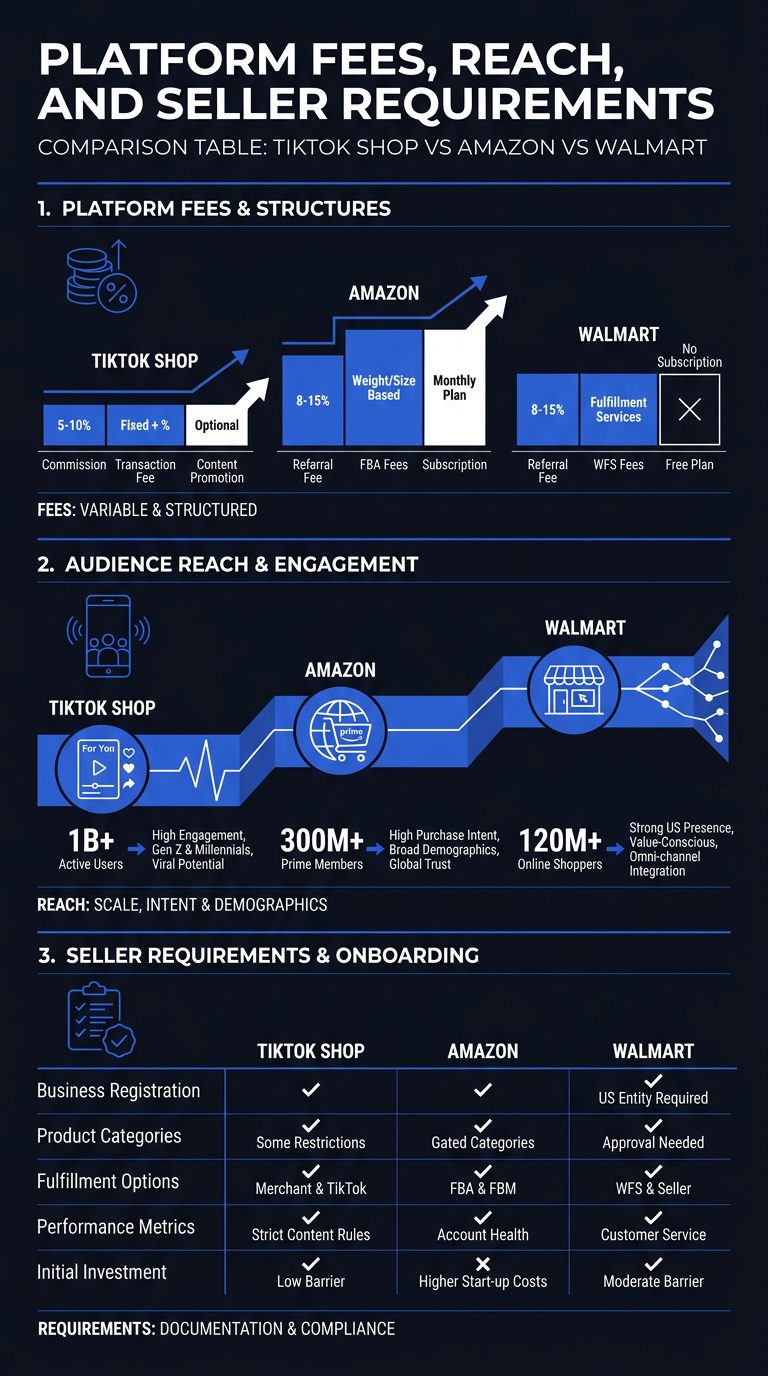
Table of contents
- TikTok Shop vs Amazon vs Walmart: Which Fits Your Brand?
- Comparison Table: Platform Fees, Reach, and Seller Requirements
- Who This Article Is Not For
- Creator Leverage: Where Influencers Actually Drive Sales
- Time to First Sale: Speed Matters in 2026
- Customer Acquisition Cost and Repeat Purchase Rate
- Inventory and Fulfillment Demands
- Advertising Spend and Algorithm Dependency
- Brand Control and Long-Term Relationship
- Cross-Border and Global Selling Capacity
- What Selling 100+ Brands Teaches Us About Platform Choice
- FAQ
TikTok Shop vs Amazon vs Walmart: Which Fits Your Brand?
The TikTok Shop vs Amazon vs Walmart decision is really a question about how demand gets created. TikTok Shop creates demand through content; Amazon captures demand that already exists; Walmart extends your physical retail presence online.
Here is who each one fits:
- TikTok Shop fits brands that want viral, creator-driven growth and are willing to produce a lot of video. The barrier to entry is low, the discovery upside is high, and the format rewards volume. Best for consumer electronics, home, gaming and lifestyle products that demo well on camera.
- Amazon fits brands with an established customer base and products people search for by name or category. Its strength is reach and recurring revenue from a shopper who is already in buying mode.
- Walmart fits CPG, grocery and household brands that need online shelf parity with their physical retail footprint, and that can work through a broker-led supplier process.
Most scaling brands do not pick one forever. They start where their product fits best and expand. The rest of this guide decides each dimension so you can sequence them.
Comparison Table: Platform Fees, Reach, and Seller Requirements
Here is how the three platforms compare across the numbers that drive the economics in 2026. Where a figure is a secondary estimate rather than an official schedule, we have labeled it.
| Attribute | TikTok Shop | Amazon | Walmart Marketplace |
|---|---|---|---|
| Core commission / referral | Contested: a secondary source reports ~8% platform fee (not officially confirmed for 2026) | Electronics 8%, Home & Kitchen 15% (2026, Amazon) | Category-based, broadly comparable to Amazon referral rates |
| Account / plan cost | No monthly seller plan fee | Professional plan: no per-item fee; Individual: $0.99 per item sold (2026, Amazon) | No monthly fee |
| Affiliate / creator economics | Avg affiliate commission ~13% of sale, range 2%-20% (2026, secondary estimate) | External influencer programs, not native | No native creator affiliate system |
| Fulfillment | 72-hour fulfillment expected; 3PL or managed | FBA fulfillment ~$3-$7 per unit (secondary estimate); +$0.08 avg per unit in 2026 | Distributor network or 3PL integration |
| Onboarding / verification | 3-10 weeks for managed brands | 2-6 weeks account approval, then time to rank | Broker-led, often 3-4 months |
| Discovery model | Content and LIVE (push) | Search (pull) | Search plus retail shelf recognition |
| Global reach | 7 countries | Mature global logistics, multi-region | North America focus |
| Best-fit categories | Electronics, home, gaming, lifestyle | Commodity and search-driven | CPG, grocery, household |
A note on reading this table: Amazon's fee schedule is the most transparent of the three, which is why its figures carry a year and a source. The TikTok Shop and Walmart commission numbers in circulation come from secondary analyses with unclear methodology, so treat them as directional, not definitive.
Who This Article Is Not For
This comparison does not apply to every seller, and three groups should stop here.
Restricted-category sellers. If you sell alcohol, weapons, certain supplements, or other regulated goods, all three platforms draw hard lines. TikTok Shop prohibits many of these outright. Amazon gates them behind approval or bans them. Walmart restricts them through its supplier compliance process. Check each platform's prohibited-products policy before you model anything.
Sellers who cannot fulfill fast. TikTok Shop expects orders shipped inside 72 hours. If you drop-ship from overseas on two-week lead times or cannot commit to a 3PL, your account health will suffer and your listings will be throttled. Amazon's FBA solves speed but requires you to send inventory in advance.
CPG brands unwilling to do creator marketing. If your team will not produce creator video or run LIVE, TikTok Shop is not your channel. The algorithm rewards volume of content, not shelf placement. A CPG brand that wants pure distribution without marketing is a better fit for Walmart or Amazon.
If you are pre-product, none of this applies yet. Build the product first.
Creator Leverage: Where Influencers Actually Drive Sales
TikTok Shop wins creator leverage, and it is not close. TikTok Shop builds affiliate tools and commissions directly into the platform, so a creator can tag your product, earn a cut, and drive a sale without ever leaving the app. Amazon relies on external influencer and associate programs that sit outside the buying flow. Walmart has no native creator system at all and runs on retail buyer relationships instead.
The gap shows up in the numbers. A 2025 secondary analysis reported that affiliate content generated 42% of US TikTok Shop GMV, with average affiliate commissions around 13% of sale value in 2026. No comparable native mechanic exists on the other two platforms.
This is the part of TikTok Shop we operate daily. According to our 2026 content production records, we produce more than 7,000 creator videos a month in-house. We handle sourcing, sampling and management through our affiliate and creator management team, so the volume the algorithm rewards actually gets made.
Winner: TikTok Shop.
Time to First Sale: Speed Matters in 2026
TikTok Shop is the fastest of the three to a first sale. For a managed brand, go-live runs roughly 3 to 10 weeks. Amazon takes 2 to 6 weeks for account approval, then additional weeks to rank a listing high enough to sell. Walmart enforces a broker-led onboarding that commonly adds 3 to 4 months before you transact.
The difference is structural. TikTok Shop can push your product to buyers through content and LIVE on day one, so you do not wait on organic ranking to build. Amazon makes you earn placement in search results. Walmart makes you earn a supplier slot first.
According to Platinum Commerce's 2026 onboarding timelines, brands moving through our accelerator typically go from onboarding to live selling in about 10 weeks. That window covers shop setup, content production, creator seeding and the first LIVE schedule. You can see the sequence on our how it works page.
Winner: TikTok Shop.
Customer Acquisition Cost and Repeat Purchase Rate
This dimension splits, so we will call both halves. TikTok Shop usually carries a higher cost to acquire a new customer, because you are paying to create demand through content and creators. Amazon offers lower acquisition cost for commodity search terms because the shopper already wants the category, but that advantage erodes as categories saturate. Walmart sits in the middle and benefits CPG brands from shelf recognition carried over from physical retail.
Repeat purchase is the other half. Amazon's Subscribe and Save plus its logged-in buying base make it the strongest for recurring revenue on consumables and commodities. TikTok Shop's repeat behavior is emerging, driven by the trust that LIVE streams build between a host and an audience over weeks.
So the winner varies by goal:
- For repeat-purchase rate on consumables: Amazon.
- For discovery and net-new customers in visual categories: TikTok Shop.
Tiebreaker when you are torn: if customers already search for your product by name, start on Amazon. If they do not know it exists yet, start on TikTok Shop.
Inventory and Fulfillment Demands
TikTok Shop wins on fulfillment flexibility, because its demands are moderate and manageable. TikTok Shop expects 72-hour fulfillment and moderate SKU counts, which a 3PL or a managed partner can cover. Amazon demands heavier inventory commitments and either FBA (you prepay to send stock in) or slower self-fulfillment. Walmart requires distributor networks or deep 3PL integration before you can reliably supply.
Amazon's fulfillment costs are moving. Amazon reported that average US FBA fees rose by $0.08 per unit in 2026, less than 0.5% of the average item selling price. The increases are uneven: small standard-size products under $10 rose an average of $0.12 per unit in 2026, while those over $50 rose an average of $0.51 per unit. Model your specific size and price tier before assuming FBA is cheap.
We run fulfillment in-house. Our fulfillment and distribution operation handles warehousing and shipping so brands hit the 72-hour window without building logistics themselves. Under our Buy & Sell model we buy your inventory at net PO cost, with no fees, then carry the stock ourselves.
Winner: TikTok Shop.
Advertising Spend and Algorithm Dependency
TikTok Shop wins on how little paid spend it can require, because organic content and LIVE can carry demand. Amazon runs on aggressive PPC; if you stop bidding, your visibility drops. Walmart leans on its demand-side platform (DSP) spend to get seen. TikTok Shop success depends more on LIVE selling and creator partnerships than on buying impressions, so a strong content engine lowers your reliance on paid.
That said, paid still matters on TikTok Shop. GMV Max ads amplify what is already converting, and we run them tied directly to shop sales and LIVE sessions rather than as a standalone channel. The point is sequencing: content first, paid to pour fuel on winners.
We never promise GMV or ROAS, and no one can. What we will say is that the dependency structure differs: Amazon and Walmart make paid spend the price of visibility, while TikTok Shop lets organic LIVE and creators do more of the work.
Winner: TikTok Shop.
Brand Control and Long-Term Relationship
TikTok Shop gives you the most brand control of the three. TikTok Shop lets you build direct creator relationships and tell your story through your own content and LIVE hosts. Amazon treats sellers as largely interchangeable listings competing on price and the buy box. Walmart enforces category caps and supplier hierarchies that limit how much of your brand comes through.
Control is why discovery-led brands lean into TikTok Shop for the long term. You own the creative, the host relationship, and the audience that tunes into your streams. On Amazon, the platform owns the customer relationship and shows them competitors on your own product page.
According to Platinum Commerce's 2026 results, we ranked #1 in TikTok Shop's Multi-Category Seller Live Sprint, which we attribute to running consistent branded LIVE from our own studio rather than scattering effort across interchangeable listings. We stream daily from 12 live rooms. You can see the setup on our live selling page.
Winner: TikTok Shop.
Cross-Border and Global Selling Capacity
Cross-border selling splits by brand maturity. Amazon wins for established global brands: it has the most mature multi-region logistics and fulfillment network, though fees stack up per region. Walmart limits you to North America. TikTok Shop operates in a focused set of markets with emerging international LIVE features.
For context, TikTok Shop runs in roughly 7 countries, which makes it strong for brands chasing growth in Southeast Asia, the UK and Europe rather than full global coverage. If you already sell in a dozen regions and need deep logistics everywhere, Amazon's infrastructure is the mature choice.
- For established global brands needing mature logistics: Amazon.
- For emerging-market growth in Southeast Asia, the UK and Europe: TikTok Shop.
Tiebreaker: if your priority is breadth of regions today, choose Amazon; if it is upside in TikTok Shop's growth markets, choose TikTok Shop.
What Selling 100+ Brands Teaches Us About Platform Choice
The clearest lesson from operating at scale: platform choice should follow how your category gets discovered. We carry 100+ brands on TikTok Shop in consumer electronics, home, gaming and lifestyle. LIVE-stream commerce and creator partnerships drive outsized returns for those discovery-led categories.
Here is the pattern we see:
- Discovery-led categories (electronics, home goods, gaming, lifestyle) win biggest on TikTok Shop, because content and LIVE create demand for products buyers were not searching for. The brands we sell on TikTok Shop include Vitamix, Lenovo, Glorious and AOSU.
- Commodity and CPG sellers do better on a pure marketplace approach, where Amazon's search intent and repeat buying carry the economics. We covered why the playbooks do not transfer in why your Amazon strategy won't work on TikTok Shop.
A deep creator network matters because it is the supply side of discovery. On a marketplace you buy keywords; on TikTok Shop you earn attention. Different engine, different build.
If your product demos well and you want to grow on TikTok Shop without building a studio, creator network and fulfillment stack in-house, that is what we do. You can book a call to talk through Buy & Sell or managed services, or review the full services list first.
FAQ
Is TikTok Shop better than Amazon for a new brand in 2026?
For a new brand in a visual, demo-friendly category (electronics, home, gaming, lifestyle), TikTok Shop is usually the faster start because creators and LIVE create demand you cannot get from Amazon search on day one. For a commodity product people already search for by name, Amazon's lower acquisition cost makes it the stronger first channel. Many brands end up on both.
How much does it cost to sell on Amazon versus TikTok Shop in 2026?
Amazon charges category referral fees of 8% on consumer electronics and 15% on home and kitchen in 2026, plus FBA fulfillment of roughly $3 to $7 per unit by secondary estimates, and either no per-item plan fee (Professional) or $0.99 per item (Individual). TikTok Shop has no monthly plan fee; its commission figures in circulation are secondary estimates, not an official 2026 schedule, so model them cautiously.
Should a CPG or grocery brand use TikTok Shop or Walmart?
A CPG or grocery brand that wants retail shelf parity and will not invest in creator video should choose Walmart, which rewards shelf recognition and distribution. A CPG brand willing to produce creator content and run LIVE can win on TikTok Shop too, but the algorithm rewards content volume, not shelf placement, so it only works if you commit to the marketing.
How fast can I start selling on each platform?
TikTok Shop can go live in about 3 to 10 weeks for a managed brand. Amazon takes 2 to 6 weeks for account approval, then more time to rank. Walmart's broker-led onboarding commonly adds 3 to 4 months. According to Platinum Commerce's 2026 onboarding timelines, brands in our accelerator typically go from onboarding to live selling in about 10 weeks.
Do I have to run paid ads to succeed on TikTok Shop?
No, but paid helps. TikTok Shop can generate demand through organic LIVE and creator content, which lowers your reliance on paid compared with Amazon PPC or Walmart DSP spend. We use GMV Max ads to amplify content and LIVE sessions that are already converting, rather than as a standalone acquisition channel. We never guarantee GMV or ROAS.
Sources
- Amazon referral fees by category (2026): Amazon Seller Central referral fee schedule
- Amazon selling plan and per-item pricing (2026): Amazon selling pricing
- Amazon referral fee calculation method: Amazon Seller Central fee reference
- FBA fulfillment fee estimates and 2026 changes: AMZ Prep FBA fees analysis and Feedvisor Amazon fees guide
- TikTok Shop affiliate GMV share and commission estimates (2025-2026): Axis Intelligence TikTok Shop statistics
Written by Ashton Asherian