The 15 questions to ask a TikTok Shop agency cover creator network size, monthly video output, live selling infrastructure, creator payment models, platform-specific experience, performance tracking, market coverage, onboarding speed, creator sourcing, underperformance protocols, fee structure, and who the service is wrong for. Asking all 15 before you sign separates agencies that actually move GMV on TikTok Shop from ones that sell you a deck.
We run this work in-house every day from our Beverly Hills studio, so these are the questions we would ask if we were the brand sitting across the table. Ask all 15 and you will know within one conversation whether an agency can run your shop or just talk about it.
Key takeaways
- The fastest filter is specificity: a real TikTok Shop agency answers with numbers (creators, videos, GMV, markets), not adjectives.
- Creator network size and monthly video volume drive your test velocity. The TikTok algorithm rewards volume, so thin production means slow learning.
- Live selling needs real infrastructure: live rooms, producers, scheduled hosts. Ask to see it.
- Insist on a contribution-margin model per order, not a revenue-only GMV or ROAS forecast.
- Full-service agencies are not for pre-product brands, ultra-thin margins, or anyone unwilling to commit to roughly 10 weeks of testing.
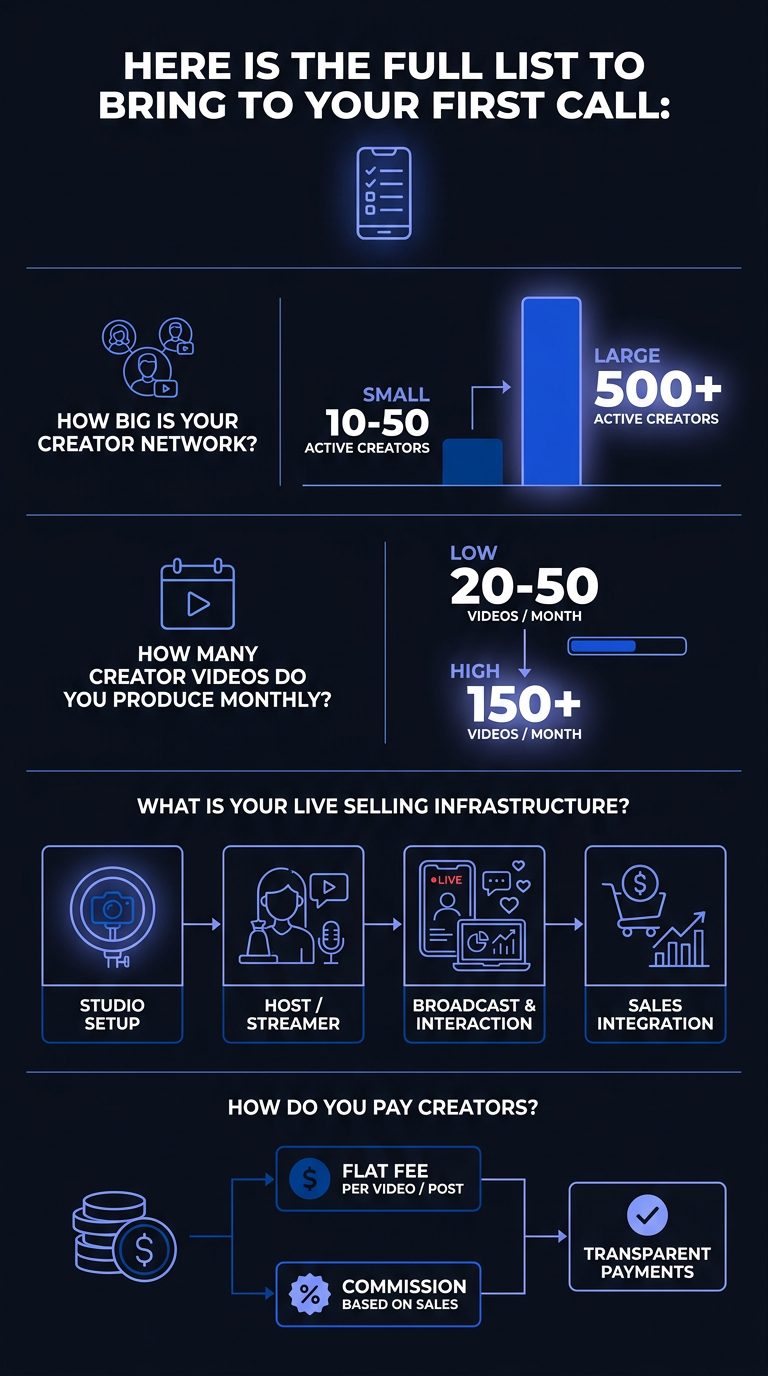
Table of contents
- 15 Key Questions to Ask a TikTok Shop Agency
- How Big Is Their Creator Network?
- How Many Creator Videos Do They Produce Monthly?
- What's Their Live Selling Infrastructure?
- How Do They Pay Creators?
- Do They Have Proven Experience on TikTok Shop Specifically?
- How Do They Track and Report Performance?
- Which Marketplaces and Regions Do They Cover?
- What's Their Onboarding Timeline and Process?
- How Do They Source Creators for Your Specific Brand?
- What Happens When a Creator Underperforms?
- Will They Work With Your Existing Creator Relationships?
- Who Is This Approach NOT For?
- What's the Investment and Fee Structure?
- FAQ
15 Key Questions to Ask a TikTok Shop Agency
The questions to ask a TikTok Shop agency fall into six buckets: creator network, content production, live selling, payment and fee structure, platform-specific proof, and performance reporting. Each one exists to expose whether an agency operates a real TikTok Shop machine or outsources the hard parts.
Here is the full list to bring to your first call:
- How big is your creator network?
- How many creator videos do you produce monthly?
- What is your live selling infrastructure?
- How do you pay creators?
- Do you have proven TikTok Shop experience, not just TikTok experience?
- How do you track and report performance?
- Which TikTok Shop markets and regions do you support?
- Who owns seller verification and brand authorization?
- What is your onboarding timeline and process?
- How do you source creators for our specific brand?
- What happens when a creator underperforms?
- Will you work with our existing creator relationships?
- How do you protect our products from policy violations?
- What is your total-cost model per order?
- What is the investment and fee structure?
The outline below groups these into the sections that matter most. For a shorter comparison framework, see our guide on how to choose a TikTok Shop agency.
How Big Is Their Creator Network?
A creator network is the pool of active TikTok creators an agency can brief, sample, and deploy to make shoppable content for your products. Scale matters because TikTok Shop rewards authentic voices at volume, and a large roster lets an agency match creators to your niche fast instead of recycling the same five faces.
Ask for a real number and how it breaks down by follower tier and category. A network spread from micro creators to seven-figure accounts gives you reach and credibility at different price points.
We manage affiliate creators through an in-house affiliate sample center. Ask every agency to put a number on its active creator network; if it cannot, it is renting access to one. See how we run this in our affiliate and creator management work.
How Many Creator Videos Do They Produce Monthly?
Monthly video output is the single clearest signal of test velocity on TikTok Shop. The algorithm rewards volume, so more videos means more angles tested, more creators in rotation, and more coverage across the feed. One-off content drops do not work here. You need continuous flow.
Ask for videos produced per month and where they are made. In-house production means faster turnarounds and tighter quality control than coordinating freelancers.
According to Platinum Commerce's 2026 content production records, we produce 7,000+ creator videos a month in-house, built for TikTok Shop product pages, affiliates, and ads. Use that as your reference for what high production actually looks like. An agency producing a few dozen videos a month is not running a growth engine, it is running a side project. More detail on our UGC and content production process.
What's Their Live Selling Infrastructure?
Live selling infrastructure means the physical and operational setup behind TikTok LIVE shopping: studio space, cameras and tech, trained hosts, producers, and a daily scheduling system. It matters because live converts well only when it runs consistently and looks professional, and that requires dedicated capacity, not a phone propped on a desk.
Ask whether the agency owns its studio, how many sessions it runs per day, and who produces them.
According to Platinum Commerce's 2026 studio data, we stream TikTok LIVE shopping from 12 live rooms in our Beverly Hills studio at 466 N Beverly Drive, and we ranked #1 in TikTok Shop's Multi-Category Seller Live Sprint. That is the kind of concrete answer to expect. Our live selling page shows the live rooms and host setup.
How Do They Pay Creators?
Creator payment models tell you how motivated and how good the creators will be. On TikTok Shop, sellers set the commission rate paid to creators and partners, according to TikTok Shop's affiliate documentation, so the model is a choice the agency makes with you, not a platform default.
The three common structures:
| Payment model | How it works | What it signals |
|---|---|---|
| Commission / revenue share | Creator earns a set percentage of each sale | Aligns creator pay with performance; attracts volume creators |
| Flat fee per video | Fixed payment regardless of sales | Predictable cost; good for top creators who won't work on spec |
| Hybrid (fee + commission) | Base payment plus sales commission | Balances risk; common for mid-tier and proven creators |
Watch for race-to-the-bottom pricing. Rates that are too low attract low-effort creators and high refund rates. A good agency sets commission by product margin, average order value, launch phase, and creator quality, and tells you whether commission applies to gross or net sales.
Do They Have Proven Experience on TikTok Shop Specifically?
TikTok Shop experience is not the same as TikTok experience. A general TikTok agency grows followers and views. A TikTok Shop specialist handles shop setup, seller verification, fulfillment, live conversion, and the Seller Center mechanics that actually produce orders. Those are different jobs.
Ask for evidence tied to the platform:
- GMV generated on TikTok Shop
- Number of brands managed and in which categories
- TikTok Shop Partner certification
- Who owns seller verification and brand authorization, since TikTok can require proof of identity, business registration, and trademark or authorized-reseller documentation per TikTok Shop's seller policies
According to our 2026 brand roster, we carry 100+ brands across consumer electronics, home, gaming, and lifestyle. We are a certified TikTok Shop Partner. For why platform-specific experience matters, read why your Amazon strategy won't work on TikTok Shop.
How Do They Track and Report Performance?
Performance tracking on TikTok Shop means reporting at the creator and order level, not a monthly vanity summary. Clear tracking prevents the surprise where GMV looks great but you lost money on refunds, discounts, and commissions. Ask how the agency defines success and what dashboards you receive.
Require reporting that includes:
- Creator-level sales, units, and conversion rate
- Average order value and ROAS
- Commission paid, refunds, cancellations, and chargebacks
- Livestream contribution and paid amplification results
- Net contribution margin per order
TikTok's terms state that seller-set payment terms govern creator commissions and that TikTok is not responsible for those arrangements, per TikTok Shop's affiliate agreement. That means your agency must track and reconcile creator pay itself. Our data and reporting rolls shop, live, and affiliate numbers into one view.
Which Marketplaces and Regions Do They Cover?
TikTok Shop is not one marketplace. It runs across multiple countries, each with its own eligibility rules, fees, creator rules, and fulfillment requirements. A U.S. consumer-product launch needs an agency fluent in the current U.S. Seller Center, fulfillment, creator-affiliate, advertising, and compliance rules, not just experience from another market.
Ask which markets the agency actively supports and whether it can distribute beyond TikTok Shop alone.
Our parent distributor runs 13 US distribution centers, and 99% of orders ship the same or next day. If you sell internationally, confirm the agency has run shops in the specific regions you target, because what works in one country's Seller Center does not transfer cleanly to the next. Our fulfillment and distribution covers the US.
What's Their Onboarding Timeline and Process?
Onboarding timeline is the span from discovery call to first live sale. Slower is not automatically safer and faster is not automatically sloppy. What matters is whether the agency has a repeatable process: verification, shop setup, creator sourcing, content production, and a first live date you can hold them to.
According to Platinum Commerce's 2026 onboarding timelines, brands working with us typically go from onboarding to live selling in about 10 weeks. Use that as a realistic benchmark for a well-structured launch-to-scale plan.
A healthy onboarding looks like this:
| Phase | Typical focus |
|---|---|
| Weeks 1-2 | Seller verification, brand authorization, shop setup |
| Weeks 3-5 | Creator sourcing, sampling, first content production |
| Weeks 6-8 | Content live, affiliate ramp, early live sessions |
| Weeks 9-10 | Live selling cadence, ads layered in, reporting live |
If an agency promises first sales in a week, ask what it is skipping. See our how it works page for the full model.
How Do They Source Creators for Your Specific Brand?
Creator sourcing is target mapping: matching a creator's audience geography, age, content style, and conversion history to your product and buyer. Not every creator works for every brand. A gaming accessory and a home appliance need different voices, and the wrong match burns samples and commission for nothing.
Ask how the agency screens creators before going live. A real process covers audience fit, historical conversion, product-category relevance, policy history, fake-engagement checks, and conflicts with competing brands, consistent with how TikTok's Affiliate program pairs creators with products.
Then ask how they test fit. Good agencies run small batches first, read the creator-level data, and scale the voices that convert instead of betting the budget on one name. We draw matches from our creator network and sample through an in-house sample center so we can test fit fast across categories.
What Happens When a Creator Underperforms?
Underperformance is normal, not a failure. Most creators in any batch will produce mediocre numbers, a few will drive the majority of sales, and the agency's job is to find the winners quickly and cut the rest. The response matters more than the miss. Ask for the exact protocol.
A strong answer includes:
- A clear window and threshold for judging a creator (sales, conversion, ROAS)
- A rule for pausing low-ROI creators before they drain budget
- A pipeline ready to replace paused creators without a gap
- Iteration on briefs, hooks, and formats, not just swapping faces
Ask how the agency reconciles commission and samples when a creator stalls. If the answer is vague, assume underperformers will sit in your program billing commission and refunds with no one watching. Volume only works when it is actively pruned.
Will They Work With Your Existing Creator Relationships?
Some brands arrive with in-house creators, ambassadors, or influencer partnerships they want to keep. Ask directly whether the agency integrates external creators or insists on its own network exclusively. The honest answer varies by agency, and neither is automatically wrong, but you need to know before you sign.
Two reasonable models:
- Integrate your creators: The agency briefs, pays, and reports on your existing partners alongside its own network. Best when you have proven creators already converting.
- Own network only: The agency runs exclusively through its roster for consistency and control. Simpler to manage, but your existing relationships sit idle.
The thing to avoid is an agency that quietly drops your creators because they are harder to track. We run managed shops where brand-supplied creators plug into the same reporting and payment system as our network, so nothing goes dark. More on that in our managed services.
Who Is This Approach NOT For?
A full-service TikTok Shop agency is not for every brand. Be honest about fit before you spend. The approach stops working in a few clear cases:
- Pre-product brands. If you do not have a product in hand and inventory to ship, a full-service accelerator cannot help you yet. Platinum Commerce does not work with pre-product brands.
- Ultra-thin margins. TikTok takes a 6% commission per sale, per the TikTok Shop seller portal, and creator commission, ads, fulfillment, and returns stack on top. If your contribution margin cannot absorb that, the math does not work.
- Tiny catalogs. One or two SKUs give creators little to test and limit AOV. Breadth helps.
- No appetite for testing. If you cannot commit to roughly 10 weeks of content, creator iteration, and live sessions, DIY in the Seller Center or a marketplace-only approach will frustrate you less.
If that is you, start with the free TikTok Shop Seller Center and revisit an agency once you have a product, margin room, and patience.
What's the Investment and Fee Structure?
Fee structure on TikTok Shop usually takes one of three shapes, and the lowest price is rarely the best value. Cheap agencies cut the parts that drive sales: production volume, live capacity, and creator vetting. Get the full cost in writing before you compare.
| Model | How you pay | Best for |
|---|---|---|
| Managed services | Base fee plus commission; you keep inventory and fulfillment | Proven products with margin room |
| Buy and sell / distribution | Agency buys your inventory at net PO cost; no fees to you | Brands wanting no upfront risk or ops load |
| Performance / hybrid | Commission or fee tied to sales | Brands sharing upside and downside |
Insist on a total-cost model per order: product cost, TikTok's 6% commission, creator commission, agency or affiliate fees, ad spend, fulfillment, shipping, refunds, returns, discounts, samples, and chargebacks. Do not accept a revenue-only ROAS or GMV forecast. Require a written breakdown separating agency fees from TikTok commissions and every other line.
Platinum Commerce runs two models: we buy your inventory at net PO cost with no fees, or we run your shop end to end for a base plus commission while you keep inventory. We do not do hourly or retainer-only work. We never promise GMV or ROAS, we explain the model. Book a call to see which fits your margins.
FAQ
What is the most important question to ask a TikTok Shop agency?
Ask for the total-cost model per order. Many agencies lead with GMV or ROAS forecasts that ignore TikTok's 6% commission, creator commission, ads, returns, and fulfillment. A contribution-margin breakdown per order tells you whether the program actually makes money, which no revenue-only number can.
Do I need a TikTok Shop specialist or will a general TikTok agency work?
You need a specialist. General TikTok agencies grow views and followers; TikTok Shop has its own mechanics for seller verification, shop setup, fulfillment, and live conversion. Ask for GMV generated, brands managed, and TikTok Shop Partner certification as proof of platform-specific experience.
How long should onboarding with a TikTok Shop agency take?
About 10 weeks is a realistic benchmark from onboarding to steady live selling, based on Platinum Commerce's 2026 onboarding timelines. That covers verification, shop setup, creator sourcing, content, and the first live sessions. Promises of sales within days usually mean steps are being skipped.
How do TikTok Shop agencies pay creators?
Through commission, flat fees, or a hybrid of both. Sellers set the commission rate paid to creators, per TikTok Shop's affiliate documentation, so the agency should set rates by product margin, AOV, launch phase, and creator quality. Avoid race-to-the-bottom rates that attract low-effort creators.
Who should not hire a full-service TikTok Shop agency?
Pre-product brands, brands with ultra-thin margins that cannot absorb TikTok's 6% commission plus creator and ad costs, tiny single-SKU catalogs, and anyone unwilling to commit to roughly 10 weeks of testing. Those brands are better served starting in the Seller Center directly.